

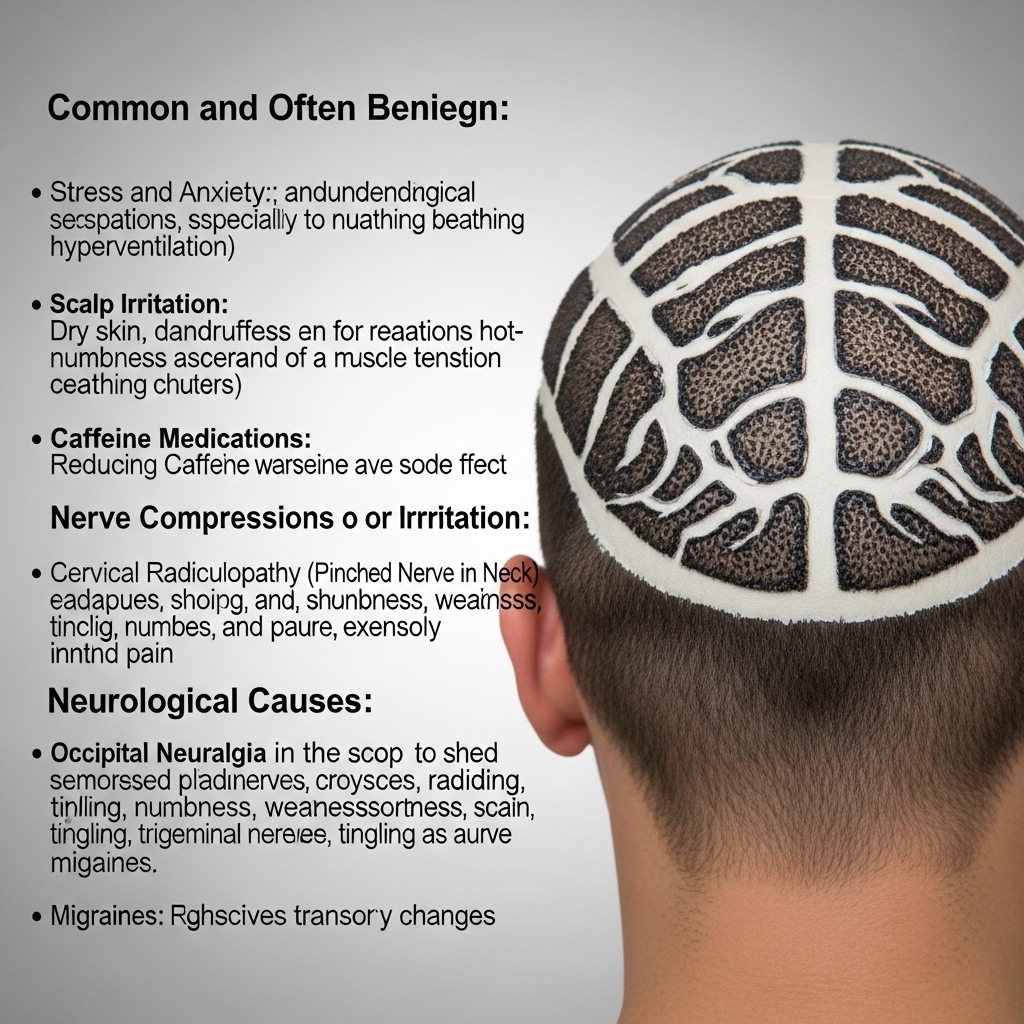
Why You Are Feeling That Tingling in Head Right Now
Have you ever been sitting quietly, maybe drinking your morning coffee or scrolling on your phone, and suddenly noticed a bizarre tingling in head that makes you completely freeze? You are definitely not alone. I know exactly how terrifying that sudden electric buzzing can feel. Last winter in Kyiv, during one of those classic, sudden temperature drops, I was sitting at my favorite little cafe in Podil working on my laptop. Out of nowhere, I felt this intense, prickly static rush across my scalp. Naturally, I panicked. I immediately went online, typed in my symptoms, and spent the next hour convincing myself I had five different incredibly rare neurological conditions.
Spoiler alert: I was totally fine. It turned out that the intense cold wind hitting my neck outside, combined with my absolutely terrible posture while working remotely for hours, were the real culprits. That buzzing, vibrating sensation—medically known as paresthesia—can often feel like a massive alarm bell going off in your nervous system. But most of the time, it is completely harmless. It is usually triggered by high stress, acute anxiety, or simple nerve compression from looking down at screens too much. However, while it might not be life-threatening, it absolutely demands your attention if it keeps coming back. Your body is trying to send you a message, and ignoring it usually just makes the tension worse. Let us break down exactly what is happening under the surface so you can stop worrying and actually do something about it.
Decoding the Sensation: What Your Body Is Trying to Say
When you feel that strange static fuzz across your scalp, it is easy to assume the worst. But your nervous system is actually highly logical. Nerves are like electrical wires; when they get pinched, stretched, or deprived of normal blood flow, they send a distorted signal to your brain. This distorted signal translates as a prickling, burning, or numb feeling. To get a grip on what is causing your specific issue, you need to play detective with your own body.
Here is a quick reference guide to help you identify what might be triggering your symptoms:
| Potential Trigger | Specific Sensation Type | Typical Duration |
|---|---|---|
| Anxiety and Chronic Stress | A tight band, prickly heat, overall fuzziness | Minutes to several hours |
| Poor Posture (Tech Neck) | Dull buzzing, localized to the back of the skull | Intermittent throughout the day |
| Cold Weather Exposure | Sharp, quick pins and needles | A few fleeting seconds |
| ASMR (Auditory Triggers) | Pleasant, relaxing shivers moving down the spine | Short bursts while listening |
Understanding the root cause gives you a massive advantage because it saves you from endless, unnecessary worry. Value Proposition: Once you correctly identify why your nerves are misfiring, you can apply highly targeted, fast-acting solutions. For example, if you realize your setup is causing the issue, fixing your ergonomic desk arrangement eliminates the nerve compression almost immediately. As another example, if you recognize that an impending deadline is making your heart race, managing those specific anxiety triggers can stop a physical panic response—and the accompanying scalp fuzz—before it even fully starts.
To pinpoint exactly what is going on, try following this simple framework:
- Pinpoint the exact location of the sensation. Is it isolated to the very top of your scalp, creeping up from the base of your skull, or localized purely on one side of your face?
- Track the duration and timing. Do you only feel it after looking at a screen for four hours straight, or does it happen right after a highly stressful phone call?
- Note any accompanying symptoms. Are you also dealing with a stiff neck, jaw clenching, mild dizziness, or a racing heartbeat?
By tracking these details, you take away the fear factor. You stop seeing it as a mysterious medical emergency and start seeing it as a predictable mechanical or emotional response that you can completely control.
Origins of Scalp Paresthesia
If we look back in history, early medical practitioners were actually quite baffled by mysterious head sensations. Ancient physicians like Hippocrates often blamed strange nerve feelings on an imbalance of the body’s “humors.” They believed that excess wind or cold trapped inside the body would rise up to the brain, creating a buzzing or vibrating feeling. While their science was obviously lacking, their observation that environmental stress and temperature affected the head was remarkably accurate.
The Evolution of Diagnosis
As medical science advanced through the 19th and 20th centuries, doctors finally began connecting the structural alignment of the cervical spine to the highly sensitive nerves running up the scalp. The industrial revolution, and later the invention of the typewriter, forced workers into unnatural, hunched positions for hours on end. This era saw a sharp rise in complaints of tension headaches and scalp tingling. Doctors eventually mapped out conditions like occipital neuralgia, proving that a pinched nerve in the neck could cause severe tingling all the way at the top of the head.
The Modern State of Neurological Awareness
Fast forward to the year 2026, and we are dealing with a totally different landscape. “Tech neck” is practically an epidemic. We are constantly hunched over our holographic displays, ultra-thin laptops, and mobile devices. Our modern lifestyle guarantees that our cervical spines are under more load than ever before in human history. The constant stream of digital information also keeps our baseline anxiety and cortisol levels remarkably high. This perfect storm of terrible physical posture and chronic digital stress means that practically everyone will experience scalp paresthesia at some point. Fortunately, modern science makes it incredibly easy to differentiate between harmless tension and actual structural nerve issues.
The Anatomy of Cranial Nerves
To really get comfortable with what you are feeling, you just need a basic understanding of your own wiring. Think of your nervous system as a highly complex electrical grid. The two main players involved in your scalp sensations are the Trigeminal nerve and the Greater Occipital nerve. The Occipital nerves emerge from your cervical spine—right around the second and third vertebrae in your neck—and travel all the way up through the muscles at the back of your head to the top of your scalp. When the heavy muscles in your neck get tight from stress or bad posture, they literally squeeze these nerves. That physical squeezing restricts the normal flow of signals, generating that weird “static” feeling.
Chemical Messengers and Sensory Overload
Beyond physical pinching, chemistry plays a massive role. When you are stressed, your brain dumps adrenaline and cortisol into your bloodstream. This activates your primitive “fight or flight” response. One of the very first things adrenaline does is trigger vasoconstriction—it narrows your blood vessels to push blood toward your major organs and muscles so you can run away from a tiger. This sudden drop in blood flow to your extremities and your skin, including your scalp, can easily cause a prickling sensation. Once you calm down and the blood vessels dilate again, the tingling stops.
- The average human scalp contains roughly 100,000 hair follicles, each directly connected to incredibly sensitive microscopic nerve endings.
- Hyperventilation caused by acute anxiety actually changes the pH level of your blood, directly triggering temporary calcium imbalances that make nerves randomly misfire.
- Occipital nerves act as the primary communication cables for the back of the head; any disruption at the neck level cascades upward instantly.
- Vasoconstriction during high-stress moments physically reduces oxygen delivery to the skin, which the brain interprets as a vibrating or fuzzy sensation.
Day 1: The Ergonomic Audit
You cannot fix nerve compression if you keep crushing the nerves. Spend today evaluating your primary workspace. Ensure your monitor is perfectly at eye level so you are not looking down. Your feet should rest flat on the floor, and your chair needs to properly support your lower back. Just lifting your screen a few inches can completely change the angle of your cervical spine.
Day 2: Breathwork Calibration
Since anxiety is a massive trigger, day two is about controlling your chemistry. Implement box breathing: inhale for four seconds, hold for four seconds, exhale for four seconds, and hold for four seconds. Doing this for just three minutes shuts down adrenaline production and stops vasoconstriction dead in its tracks.
Day 3: Cervical Stretching
Tight neck muscles squeeze the occipital nerves. Dedicate ten minutes today to gentle stretching. Slowly drop your ear to your shoulder and hold for thirty seconds on each side. Practice gentle chin tucks to build the deeper muscles in the front of your neck, which relieves the constant tension at the base of your skull.
Day 4: Hydration and Electrolytes
Your nerves run on electrical impulses, and they need water and minerals to function. Dehydration causes muscle cramps and nerve sensitivity. Drink at least two liters of water today and consider adding a high-quality magnesium supplement. Magnesium acts as a natural muscle relaxant and calms an overactive nervous system.
Day 5: Screen Fasting
Digital eye strain translates directly into jaw and neck tension. Try taking a strict two-hour break from all screens before bed. The reduction in blue light will lower your cortisol levels naturally, allowing your muscles to fully relax while you sleep, preventing overnight nerve compression.
Day 6: Heat and Cold Therapy
Increase blood flow to the affected area. Apply a warm, moist towel to the back of your neck for fifteen minutes. The heat forces blood vessels to dilate, rushing fresh oxygen to the trapped nerves. If you have active inflammation or sharp pain, alternate with a cold ice pack wrapped in a cloth to numb the misfiring nerves.
Day 7: Posture Reset and Maintenance
Combine everything you have learned. Set a timer on your phone to go off every hour. When it beeps, do a quick posture check: pull your shoulders back, tuck your chin slightly, and take a deep, grounding breath. Consistency is the only way to keep the tingling away permanently.
Busting Common Nervous System Myths
Myth: Feeling a weird vibration in your head means you are actively having a stroke or a severe medical emergency right now.
Reality: While extremely serious conditions do exist, a tingling sensation entirely on its own—without alarming symptoms like severe facial drooping, slurred speech, or total loss of balance—is almost always just muscle tension or an anxiety response.
Myth: You need to book expensive, complex brain scans to figure out why your scalp feels fuzzy.
Reality: The vast majority of paresthesia cases resolve quickly with basic, free lifestyle adjustments like improving your desk posture, stretching your neck, and managing daily stress levels.
Myth: The physical feeling is just your imagination playing cruel tricks on you.
Reality: Paresthesia is a highly measurable, purely physical response. Even if it is triggered by an emotional state like anxiety, the nerve misfiring happening in your scalp is a real, physical event.
Can anxiety really make my scalp buzz?
Yes, absolutely. High anxiety releases adrenaline, which tightly constricts blood vessels. That rapid shift in normal blood flow easily causes your highly sensitive scalp nerves to feel prickly.
When should I immediately see a doctor?
You should seek urgent medical help if the sensation is suddenly accompanied by severe weakness on one side of your body, sudden vision changes, difficulty speaking, or the worst headache of your life.
Does a severe lack of sleep cause this?
Definitely. Sleep deprivation keeps your nervous system in a heightened state of alert. Tired nerves are far more likely to misfire and send random static signals to your brain.
Can drinking too much caffeine trigger paresthesia?
Yes. Caffeine is a powerful central nervous system stimulant. Drinking too much can cause muscle twitching and force your blood vessels to constrict, leading directly to a tingling feeling.
Is this related to the ASMR trend?
Sometimes! ASMR (Autonomous Sensory Meridian Response) is actually a positive, deeply relaxing form of paresthesia, usually triggered by specific sounds or visual stimuli.
Can seasonal allergies cause weird head feelings?
They can. Severe allergies cause intense sinus inflammation and pressure. That heavy pressure inside your facial cavities can mildly compress local nerves, radiating a strange feeling upward.
How fast does tension relief usually work?
If the cause is purely postural or stress-based, you can often feel significant relief within a few days of consistently correcting your posture and applying heat therapy.
If you felt that weird sensation today, do not let panic take over. You are highly likely dealing with tight muscles, too much screen time, or a little extra stress. Adjust your desk posture, take a few deep breaths, and listen to the signals your body is giving you. Take action on the 7-day plan above, and hit reply or share this guide with a friend who works stooped over a laptop all day!

Leave a Reply