

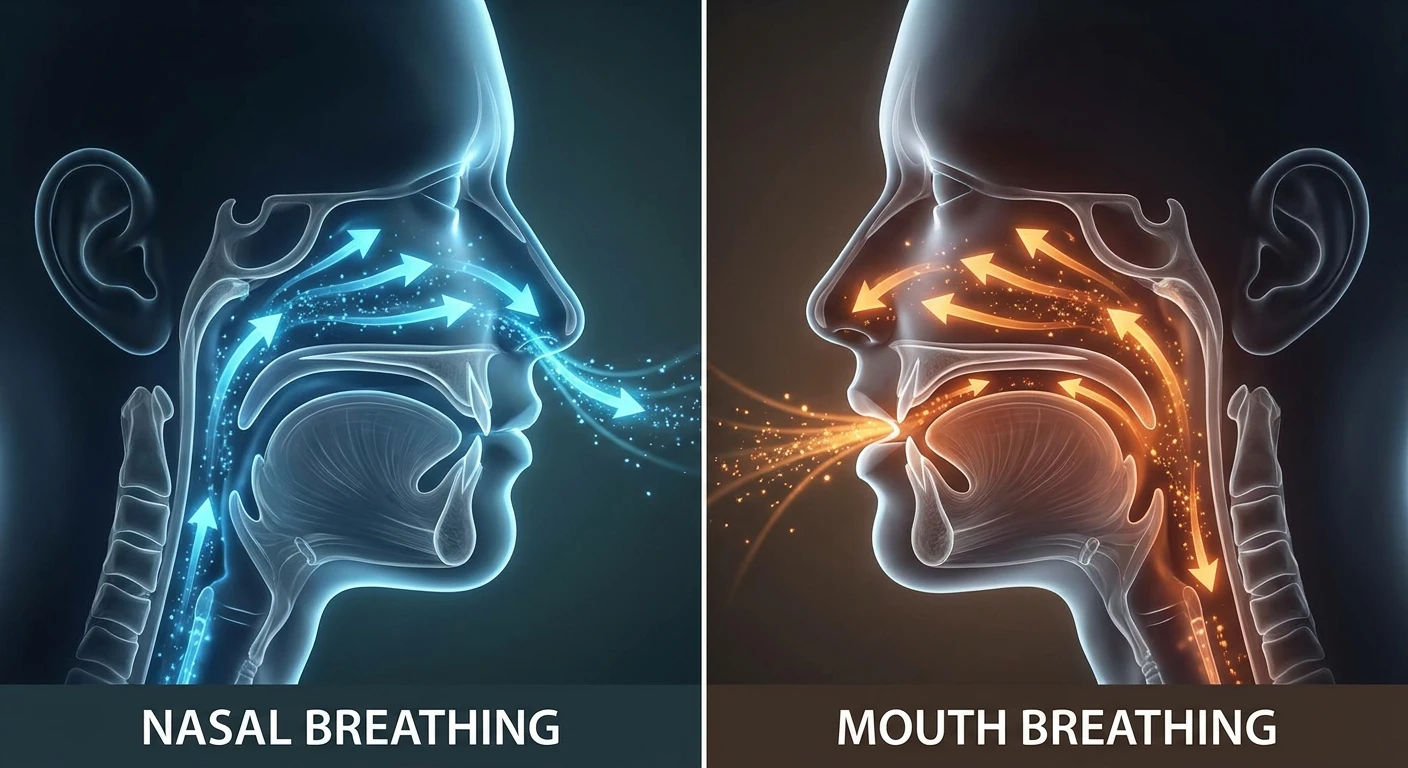
Mouth Breather vs Nose Breather: Understanding the Health Impact
When looking at the daily habits that quietly shape human health, the debate of mouth breather vs nose breather stands out as one of the most critical. You take approximately 20,000 to 25,000 breaths every single day. For a long time, conventional thinking suggested that air is just air, and how it enters the lungs doesn’t really matter as long as you get enough of it. However, modern physiology tells an entirely different story. The entry point of your breath dictates cellular oxygenation, facial bone structure, immune defense, and even the quality of your deep sleep. Nasal breathing optimizes oxygen delivery and protects the delicate tissues of the lungs, whereas oral breathing triggers stress responses, dehydrates the airway, and disrupts facial development.
By the time we hit the year 2026, respiratory optimization has moved past elite athletic circles and firmly into mainstream wellness. Whether you are dealing with afternoon brain fog, chronic dental issues, or restless nights, the root cause might just be hanging right beneath your nose. The mouth is essentially a digestive organ equipped for eating, drinking, and communicating. The nose is a complex respiratory organ designed to filter, warm, humidify, and chemically alter incoming air. Understanding this fundamental biological division is the first step toward reclaiming your stamina and protecting your long-term health. The thesis is simple: breathing through your nose builds resilience and vitality, while chronic mouth breathing slowly drains your physical resources.
Read also: How to Cure Sinus Pressure Without Congestion; How To Get Your PH Balance Back To Normal Overnight.
The Core Mechanics: Why the Airway Path Matters
To grasp the massive chasm between a mouth breather and a nose breather, you have to look at what happens to a cubic centimeter of air the moment it crosses your facial threshold. Nasal breathing acts as a sophisticated environmental conditioning system. As air travels through the nasal conchae—the seashell-like bony structures inside your nose—it spins, warms to body temperature, and picks up moisture. This means that by the time the air reaches your sensitive lung tissue, it is perfectly conditioned to prevent irritation. Conversely, gulping air through the mouth sends cold, dry, unfiltered air straight into the lungs, which can trigger bronchospasms and asthma-like symptoms.
There is also a massive value proposition in switching your breathing modality. Correcting this habit provides immediate and long-term health upgrades. Consider two practical examples: First, amateur runners who consciously tape their mouths during training initially experience severe ‘air hunger,’ but within weeks, their heart rate drops at the same pace, and their lactic acid buildup decreases. Second, chronic snorers who train themselves to keep their lips sealed at night frequently report a cessation of dry mouth and a dramatic increase in REM sleep, simply because the jaw is no longer falling back and obstructing the airway.
| Physiological Feature | Nose Breathing | Mouth Breathing |
|---|---|---|
| Air Filtration | Excellent (cilia trap dust and pathogens) | None (particles bypass straight to lungs) |
| Nitric Oxide Production | High (boosts vasodilation and immunity) | Virtually Zero |
| Dental Health | Protects enamel by maintaining saliva pH | Dries saliva, highly increases cavity risk |
Transitioning from an oral respiratory habit to a nasal one requires conscious effort. If you want to begin this transition, you need to follow a structured approach. Here are the initial steps to regain control of your airway:
- Establish Daytime Awareness: Set an hourly timer on your phone. When it rings, simply check your jaw position. Your lips should be gently sealed, teeth slightly apart, and the entire tongue resting lightly against the roof of the mouth.
- Clear Nasal Obstructions: You cannot breathe through a blocked tube. Utilize saline rinses, prioritize a clean sleeping environment to reduce dust mites, and address any chronic low-grade allergies that force your mouth open.
- Practice Gentle Lip Sealing: Engage the orbicularis oris muscle (the ring of muscle around your mouth). If you have been a chronic mouth breather, this muscle may be weak. Practice holding a small piece of paper between your lips while working at your desk to build muscle memory.
Origins of Human Breathing Patterns
To understand how we arrived at a point where a large portion of the population struggles with basic respiration, we must look at our ancient origins. Early hominids and ancient hunter-gatherers were obligate nasal breathers. Survival in harsh, unpredictable environments demanded an acute sense of smell to detect predators, locate water, and identify safe food sources. The nasal cavity was essential for warming freezing air during ice ages and trapping arid dust in desert climates. Fossil records and ancient skulls consistently demonstrate broad, expansive facial structures with wide dental arches and massive nasal passages, perfectly suited for high-volume nasal respiration.
Evolution of Respiratory Habits
The shift began with the agricultural revolution and accelerated dramatically during the industrial age. As human diets shifted from tough, raw meats and fibrous roots to softer, cooked grains, the physical demand on the human jaw plummeted. Chewing stresses the facial bones, prompting them to grow thick and wide. Without this mechanical stress, subsequent generations began developing narrower jaws and smaller palates. Because the roof of the mouth is also the floor of the nasal cavity, a narrow palate directly translates into a cramped, restricted nasal airway. This evolutionary dietary shift laid the biological groundwork that made it physically harder for modern humans to breathe exclusively through their noses.
The Modern State of Airway Health
Today, the epidemic of poor breathing mechanics is compounded by indoor, sedentary lifestyles. We spend the majority of our time in heavily insulated, poorly ventilated buildings filled with synthetic materials, pet dander, and dust. This constant exposure to allergens triggers chronic low-grade inflammation of the adenoids and nasal mucosa. When the nose gets stuffed up, the mouth drops open to compensate. Add to this the modern “tech neck” posture—slouching over screens compresses the diaphragm and pushes the head forward, a position that naturally causes the jaw to hang open. We are living in an environment perfectly engineered to promote oral breathing.
The Role of Nitric Oxide
One of the most critical scientific discoveries regarding respiratory health is the role of nasal Nitric Oxide (NO). When you inhale through your nose, the air passes by the paranasal sinuses, which continuously produce NO. This miracle molecule is carried into the lungs, where it acts as a potent vasodilator. It forces the blood vessels in the alveoli to expand, which can increase oxygen absorption in the blood by 10 to 18 percent compared to mouth breathing. Furthermore, NO possesses strong antifungal, antiviral, and antibacterial properties, effectively sterilizing the air before it interacts with your internal organs.
Craniofacial Development Mechanics
The mechanics of how breathing dictates face shape are rooted in Wolff’s Law, which states that bone adapts to the loads under which it is placed. The tongue is a powerful muscle that belongs entirely on the roof of the mouth. When the tongue rests there, it exerts outward pressure on the maxilla (the upper jaw), keeping the dental arch wide and the cheekbones prominent. When a child breathes through their mouth, the tongue drops to the floor of the mouth to let air pass. Without the tongue’s scaffolding, the cheek muscles push inward, resulting in a long, narrow face, recessed chin, and crowded teeth—a condition clinically recognized as “adenoid face.”
- Nasal airway resistance is roughly 50% greater than oral airway resistance, which forces a slower, more controlled exhalation.
- Slower exhalations grant the lungs additional time to extract oxygen and facilitate proper gas exchange.
- Chronic open-mouth breathing blows off excessive amounts of carbon dioxide, which disrupts blood pH and triggers the Bohr effect, causing red blood cells to hold onto oxygen instead of releasing it to the brain and muscles.
- Oral respiration during sleep significantly increases the likelihood of the tongue collapsing backward, triggering Obstructive Sleep Apnea (OSA).
Day 1: The Baseline Assessment
Begin your transition by simply observing. Do not try to forcefully change anything on the first day. Keep a notepad nearby and tally every time you catch yourself with your mouth open while answering emails, driving, or watching television. Assess your wake-up state—do you have a dry mouth, a sore throat, or a groggy headache? Establishing this baseline is crucial for tracking your progress over the next week.
Day 2: Daytime Posture Correction
Focus entirely on oral posture. The mantra for today is: “Lips together, teeth slightly apart, tongue on the roof.” Make a clicking sound with your tongue and hold it on the roof of your mouth just behind your front teeth. This is the natural resting position. Remind yourself to reset to this posture every time you stand up or sit down.
Day 3: The Nasal Clearing Protocol
If your nose is perpetually blocked, today is the day you clear the pathways. Use a high-quality saline nasal spray or a neti pot to wash out allergens and mucus. If you have chronic inflammation, consult a doctor about safe, short-term anti-inflammatory sprays. Keep the environment humidified to prevent the mucous membranes from drying out and swelling.
Day 4: Light Exercise Integration
Take a brisk 30-minute walk while maintaining a strict lip seal. You will likely feel a sense of air hunger, a slight panic that you aren’t getting enough oxygen. This is merely your brain reacting to higher carbon dioxide levels, not a lack of actual oxygen. Slow your walking pace if necessary, but do not open your mouth. Train your chemoreceptors to tolerate normal CO2 levels.
Day 5: Sleep Environment Optimization
Prepare your bedroom for optimal night-time respiration. Vacuum thoroughly to remove dust mites. Keep pets out of the bed to minimize dander. Lower the room temperature slightly, as cooler rooms promote deeper sleep and reduce nasal congestion. Elevate your head slightly with an ergonomic pillow to prevent fluid from pooling in your sinuses.
Day 6: The Mouth Taping Experiment
Acquire porous, hypoallergenic medical tape (often sold specifically for sleep). Place a small piece vertically across the center of your lips right before bed. The goal is not to hermetically seal your mouth shut, but to provide a gentle physical reminder to your jaw muscles to stay closed. If you wake up and have pulled the tape off in your sleep, do not worry—this is a normal part of the adaptation process.
Day 7: Cardiovascular Stress Testing
Step up your physical exertion. Go for a light jog or do a moderate cycling session. The objective is to push your heart rate up while maintaining strict nasal breathing. When the urge to open your mouth becomes overwhelming, do not gasp; simply reduce your physical intensity until you recover control. This builds incredible diaphragmatic strength and cardiovascular efficiency.
Myths & Reality
Myth: Breathing through the mouth brings in more oxygen because the opening is larger.
Reality: While the volume of air entering is larger, it leads to hyperventilation. You expel too much carbon dioxide, causing your blood vessels to constrict and actually reducing the amount of oxygen delivered to your brain and tissues.
Myth: You only need to worry about how you breathe if you have asthma or lung disease.
Reality: Even healthy individuals suffer from poor sleep, brain fog, increased stress levels, and accelerated dental decay if they habitually breathe through their mouths.
Myth: Snoring is just a natural sign of a very deep, restful sleep.
Reality: Snoring is a red flag indicating airway turbulence and obstruction. It means the jaw has fallen open, the airway is narrowed, and the body is struggling to maintain proper blood oxygen saturation.
Does nasal breathing change face shape?
Yes, particularly in growing children. Proper tongue posture associated with nasal breathing guides the upper jaw to grow forward and wide, creating a well-defined facial structure and allowing enough room for all adult teeth.
Can I run with my mouth closed?
Absolutely. It takes several weeks of dedicated practice to overcome the initial sensation of air hunger, but eventually, nasal breathing during runs leads to better stamina, lower heart rates, and faster recovery times.
Is mouth taping dangerous?
It is very safe for the vast majority of healthy adults, provided you use the correct porous tape designed for the skin. Avoid it only if you have severe structural nasal blockages, are heavily intoxicated, or are currently dealing with a severe respiratory infection.
What causes chronic mouth breathing?
It often starts in childhood due to enlarged adenoids, tonsils, or chronic allergies. Even after the initial blockage resolves, the muscle memory remains, turning an emergency reflex into a permanent, damaging habit.
How do I stop mouth breathing at night?
The most effective strategy combines clearing the nasal passages before bed with the use of gentle sleep tape. Elevating the head and side-sleeping also prevent the tongue from falling back into the throat.
Does nasal breathing lower heart rate?
Yes. Slow, deliberate breaths through the nose engage the diaphragm fully, which stimulates the vagus nerve. This shifts the nervous system out of “fight or flight” mode and directly slows down the resting heart rate.
Why do I wake up with a dry mouth?
A dry mouth upon waking is the most obvious, undeniable symptom that you spent the night breathing through your mouth. The constant airflow evaporates saliva, stripping away the natural protective enzymes your teeth and gums rely on.
Taking control of your respiration is one of the most immediate, impactful physiological upgrades you can make. The divide between a mouth breather vs nose breather is the divide between surviving and thriving. By respecting the biological design of your airway, you protect your facial structure, boost your immune defenses, and ensure your brain gets the oxygen it demands. Take the challenge tonight: clear your sinuses, correct your tongue posture, and shut your mouth for a better, healthier tomorrow.

Leave a Reply