

Understanding and Relieving Hamstring Tightness
If you constantly feel a dull ache or sharp pull behind your thighs the moment you bend over or try to stride out, that hamstring tightness is a physical roadblock you cannot afford to ignore. Experiencing this restriction is incredibly common, yet the underlying causes are rarely just about needing to stretch more. The posterior chain of your body serves as the primary engine for movement, acting as a crucial bridge between your lower back, pelvis, and knees. When the muscles in this chain lose their elasticity, your entire structural alignment pays the price.
Think of your body as an intricate system of pulleys and levers. When the muscles at the back of your leg shorten and stiffen, they yank downward on your pelvis. This constant pulling flattens out the natural curve of your lower back, forcing other muscles to work overtime just to keep you upright. You feel this directly as fatigue, sluggishness, and restricted mobility. Fixing this issue requires a strategic approach rather than random toe-touches. By understanding the anatomy, the biomechanics of how tension develops, and the daily habits that reinforce it, you can systematically dismantle the stiffness and restore your natural range of motion.
Read also: Fix pain in back of knee when straightening leg; Pain Under Armpit: Causes, Symptoms, and Complete Action Pla.
The Impact of Tension: Benefits, Harms, and How to Measure It
Living with chronic posterior stiffness does more than just make tying your shoes uncomfortable; it creates a cascade of biomechanical dysfunctions. Conversely, resolving this tension drastically improves your physical output and daily comfort. When your muscles function at their optimal length-tension relationship, you generate more power, absorb impact better, and maintain an upright posture with minimal effort.
| Condition Origin | Immediate Symptoms | Long-Term Impact |
|---|---|---|
| Postural Strain (Anterior Tilt) | Lower back ache, pelvic stiffness | Chronic lumbar pain, disc compression |
| Sedentary Shortening | Stiffness after standing up, heavy legs | Reduced hip mobility, glute amnesia |
| Athletic Overuse | Cramping, sharp twinges during sprints | Severe muscle tears, tendonopathy |
Addressing the root of the problem offers immense value to your physical performance. Consider two clear examples of this value proposition. First, for anyone engaging in weightlifting, optimal muscle length allows for a flawless hip hinge. This means your deadlifts and kettlebell swings become significantly more powerful because the glutes and hamstrings can contract fully without fighting opposing tension. Second, for runners and field athletes, increased flexibility translates directly to a longer, more efficient stride, cutting down sprint times while simultaneously lowering the risk of catastrophic muscle tears mid-stride.
Before you begin a rehabilitation protocol, you need a baseline. Here is a simple, effective way to gauge the severity of your restriction:
- The Active Straight Leg Raise: Lie flat on your back with your legs fully extended. Keeping one leg firmly on the floor, slowly raise the other leg toward the ceiling without bending the knee. If you cannot reach at least an 80-degree angle without your knee bending or your opposite leg popping up, you have significant shortening.
- The Sit-and-Reach Assessment: Sit on the floor with your legs straight out in front of you. Keep your back flat and hinge at the hips, reaching toward your toes. If you feel a pulling sensation behind your knees before you even reach your shins, neural tension might be compounding your muscle stiffness.
- The Pelvic Tilt Observation: Stand sideways in front of a mirror in your natural posture. Look at your belt line. If the back of your belt is pulled significantly lower than the front, your tight posterior muscles are likely dragging your pelvis into a posterior tilt, which demands immediate corrective action.
Biological Origins of Human Locomotion
To grasp why these specific muscles are so prone to dysfunction, look back at the evolutionary history of human locomotion. Millions of years ago, as early hominids transitioned from dwelling in trees to walking upright on the African savanna, the entire anatomy of the pelvis and lower limbs had to restructure. The hamstrings evolved into massive, powerful bands of tissue designed to propel the body forward. They became the primary decelerators of the leg during running, contracting eccentrically to stop the lower leg from snapping forward too far. This evolutionary upgrade made persistence hunting possible, turning humans into elite long-distance trackers. However, this same dense, power-focused cellular structure makes the muscle group inherently prone to extreme tightness when not put through its full, evolutionary intended range of motion on a daily basis.
The Evolution of Sedentary Lifestyles
The industrial revolution drastically altered our daily physical requirements. Suddenly, survival no longer depended on walking ten miles a day or squatting deeply to forage. The invention and mass proliferation of the chair fundamentally changed how the human body rests. When you sit in a chair with your knees bent at a 90-degree angle, the muscles at the back of your thigh are placed in a shortened position. Over decades, this constant mechanical slack tells your central nervous system that the extra muscle length is no longer required. The tissue physically adapts, laying down collagen cross-links that cement the muscle into this new, shortened state. The modern convenience of sitting essentially reverse-engineered our evolutionary advantage.
Modern State of Hamstring Health
Today, posterior chain stiffness is an absolute epidemic. The transition to knowledge-based, desk-bound work environments means the average person spends up to ten hours a day sitting. Even those who exercise regularly often fall into a trap. They sit all day at a desk, commute in a car, and then go to the gym to perform heavy squats or sprint on a treadmill. Going from extreme passive shortening to explosive athletic demand without proper transition is a recipe for disaster. The modern state of human movement requires proactive, daily intervention to combat the creeping stiffness caused by our environment.
The Biomechanics of the Posterior Chain
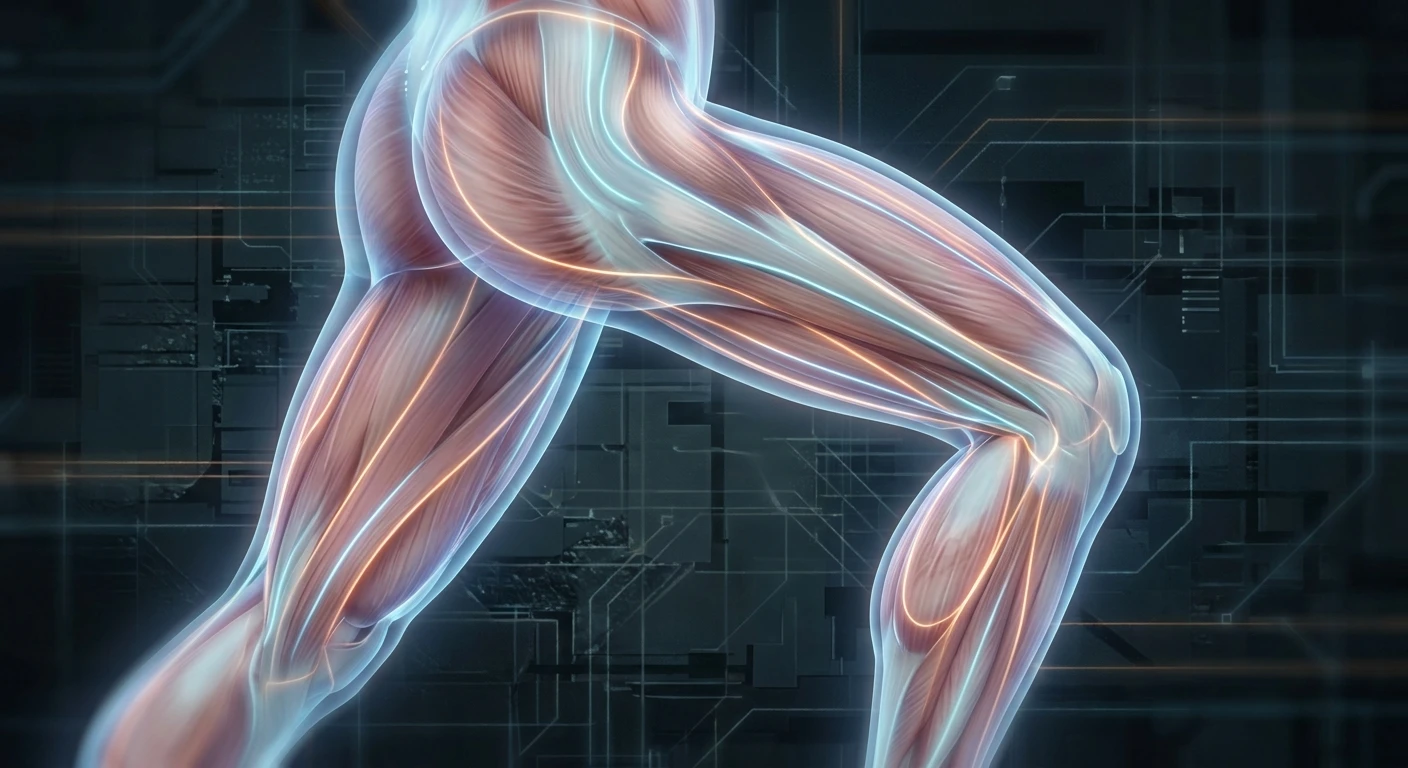
Understanding the mechanical engineering of your legs requires looking at the specific muscles involved. The hamstring is not a single muscle, but a complex group of three distinct muscles: the biceps femoris, the semitendinosus, and the semimembranosus. All three originate at the ischial tuberosity—the hard bones at the base of your pelvis you feel when you sit—and attach down below the knee joint on the tibia and fibula. Because they cross two major joints (the hip and the knee), they serve a dual purpose. They extend the hip backward and flex the knee. When they become chronically tense, they create a tug-of-war between your lower back and your calves, disrupting the biomechanics of your entire stride and posture.
Neurological Factors: Stretch Reflex and Tension
Stiffness is not just a mechanical issue; it is a neurological defense mechanism. Your muscles are embedded with specialized sensory receptors that constantly communicate with your spinal cord. When you try to stretch a muscle too quickly or too forcefully, the nervous system perceives this as a threat and actively fights back. Understanding this neural communication is the key to tricking your body into letting go of its tension.
- Muscle Spindles: These are stretch receptors located deep within the muscle belly. When they detect a rapid change in length, they trigger a reflex contraction to prevent the muscle from tearing. This is why bouncing during a stretch actually makes you tighter.
- Golgi Tendon Organs (GTOs): Located at the junction where muscle meets tendon, GTOs measure tension. If you hold a stretch gently and consistently for over 30 seconds, the GTOs override the muscle spindles, forcing the muscle to relax. This mechanism is called autogenic inhibition.
- Reciprocal Inhibition: When you actively contract the muscle on one side of a joint, the nervous system automatically relaxes the opposing muscle. Flexing your quadriceps firmly can neurologically force your hamstrings to release their grip.
- Fascial Adhesions: Sometimes the tension isn’t in the muscle fibers themselves, but in the fascia—the connective tissue wrapping the muscles. Lack of movement causes this webbing to become sticky and thick, physically gluing muscle fibers together.
Day 1: Gentle Assessment and Foam Rolling
Your first day is all about breaking down fascial adhesions without triggering a neurological defense response. Do not force any deep stretches today. Instead, use a firm foam roller or a lacrosse ball to massage the back of your thighs. Sit on the floor, place the roller under your legs, and slowly roll from the base of your glutes down to just above the back of the knee. When you find a tender, ropey spot, hold the pressure there for 30 to 60 seconds until you feel the tissue begin to yield. This myofascial release hydrates the tissue and prepares it for lengthening.
Day 2: Dynamic Warm-ups and Glute Activation
Passive stretching is useless if the surrounding muscles are weak. Often, the back of the legs tighten up because the gluteal muscles are inactive—a condition called synergist dominance. Today, focus on movement. Perform dynamic leg swings, lightly swinging your leg forward and backward to pump blood into the area. Follow this with three sets of glute bridges. Lie on your back, squeeze your glutes, and lift your hips. Teaching your glutes to fire properly takes the mechanical load off your legs, allowing them to finally relax.
Day 3: Static Stretching Protocol
Now that the fascia is mobilized and the glutes are firing, you can introduce static holds to trigger the Golgi tendon organs. Perform a seated single-leg hamstring stretch. Keep your back completely straight and hinge entirely from the hips. The moment your spine rounds, you lose the leverage on the muscle. Hold this position of mild discomfort—never sharp pain—for a full 60 to 90 seconds per leg. Breathe deeply through your stomach to signal safety to your central nervous system.
Day 4: Active Release and Eccentric Loading
Building strength at the end range of motion is the secret to permanent flexibility. You will achieve this through eccentric loading—lengthening the muscle under tension. Perform Romanian deadlifts (RDLs) with a very light weight or just a broomstick. Keep your knees slightly bent, push your hips back as far as they will go, and lower the weight slowly over a count of four seconds. Feel the deep stretch, then squeeze your glutes to stand back up. This physically builds new muscle units in series, creating true, lasting length.
Day 5: Addressing the Hips and Lower Back
The posterior chain is interconnected. If your hip flexors are brutally tight from sitting, they tilt your pelvis forward, which constantly pre-stretches and strains the back of your legs. Today, stretch the front of your body. Perform kneeling hip flexor stretches, ensuring you tuck your tailbone underneath you to isolate the stretch. Additionally, mobilize your lower back with gentle cat-cow yoga transitions. Releasing the surrounding architecture relieves the constant mechanical tug-of-war on your legs.
Day 6: Proprioceptive Neuromuscular Facilitation (PNF)
PNF stretching is a highly effective way to hack your nervous system. Lie on your back and loop a resistance band or towel around one foot. Raise the leg until you feel a moderate stretch. Now, actively push your foot down against the towel, contracting the hamstring at 30% effort for 7 seconds. Exhale, completely relax the leg, and gently pull it into a slightly deeper stretch. Repeat this contract-relax cycle three times per leg. You will notice significant gains in range of motion immediately.
Day 7: Integration and Long-Term Maintenance
Your final day establishes the routine you will carry forward. Flexibility is not a destination; it is a daily habit. Combine the foam rolling from Day 1, the glute activation from Day 2, and the eccentric loading from Day 4 into a quick 10-minute daily routine. Evaluate your workspace. If you sit for a living, commit to standing up every 45 minutes to perform five bodyweight squats. Consistent, low-intensity movement throughout the day is far more effective at combating stiffness than one intense stretching session a week.
Myths and Realities of Posterior Chain Flexibility
Myth: You should stretch through sharp pain to forcefully lengthen the muscle fibers.
Reality: Sharp pain instantly triggers the stretch reflex, causing the muscle to aggressively contract to protect itself. Pushing through this defense mechanism leads directly to micro-tears and scar tissue, which ultimately makes the muscle much tighter.
Myth: This specific stiffness is only a problem for high-level athletes and runners.
Reality: Office workers and inactive individuals suffer equally, if not more. While athletes experience tension from overexertion, sedentary individuals suffer from adaptive shortening caused by keeping the knees bent in a chair for thousands of hours a year.
Myth: Being able to touch your toes is the ultimate indicator of hamstring flexibility.
Reality: Toe-touching is highly dependent on the length of your arms, the proportions of your torso, and the mobility of your lumbar spine. You can have incredibly flexible legs and still fail to touch your toes if your upper back is completely locked up.
Myth: If a muscle feels tight, the only solution is to stretch it endlessly.
Reality: A muscle often feels tight because it is mechanically weak and acting as a parking brake for the pelvis. Strengthening the muscle through eccentric resistance training is frequently much more effective than passive stretching.
Why do my hamstrings feel tight even after I stretch?
If they feel tight immediately after stretching, you are likely dealing with a neurological stability issue rather than physical shortness. The nervous system perceives a lack of strength in the new range of motion and artificially tightens the muscle to protect the joint from injury.
Can tight hamstrings cause knee pain?
Yes. Because the muscles attach below the knee joint on the tibia and fibula, chronic tension can alter how your kneecap tracks during movement. This constant friction frequently leads to dull, aching pain right behind the knee.
How long does it take to fix this issue?
While you can experience temporary relief neurologically in a single session, actual physiological tissue lengthening and architectural remodeling of the collagen fibers take consistent daily effort over six to eight weeks.
Is yoga effective for posterior chain stiffness?
Yoga is highly effective because it combines active mobility, deep diaphragmatic breathing, and prolonged static holds. The breathing component is particularly useful for signaling the parasympathetic nervous system to drop the muscular guard.
Should I use a massage gun before or after a workout?
Use it briefly before a workout to stimulate blood flow and down-regulate the nervous system for better mobility. Use it after a workout for longer, sustained periods to aid in clearing metabolic waste and relaxing the muscle fibers.
Does sleeping position affect muscle tension?
Absolutely. Sleeping in a tight fetal position keeps your knees bent and your hips flexed for eight hours straight, mimicking the exact posture of sitting in a chair and reinforcing adaptive shortening.
Can dehydration make my muscles tighter?
Yes. The fascial tissue that surrounds your muscle fibers requires water to slide smoothly. When you are dehydrated, this connective tissue becomes stiff, sticky, and restricts the sliding filaments of the muscle, creating a sensation of extreme stiffness.
Tackling tight muscles is entirely within your control once you stop treating it as a chore and start treating it as fundamental body maintenance. By implementing the 7-day plan, listening to your nervous system, and moving away from passive stretching alone, you will rebuild your structural integrity. Start Day 1 of the protocol today, hydrate your tissues, and reclaim the smooth, pain-free mobility you were built for.

Leave a Reply