

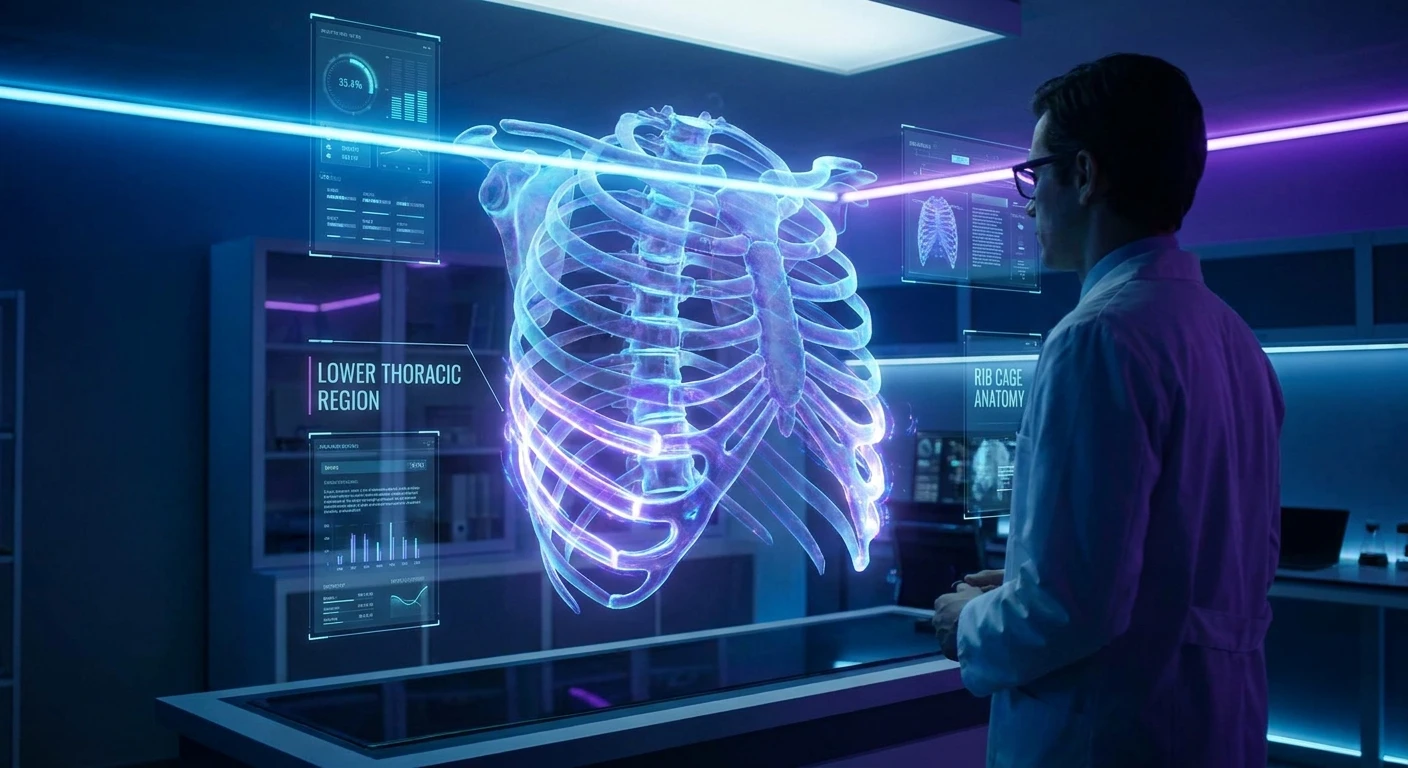
What You Should Know About Your floating rib
You probably never think about your floating rib until you twist the wrong way during a workout and feel a sudden, sharp pinch. Seriously, it is one of those body parts you totally ignore until it starts screaming at you. Hey, we have all been there. Just last month, I was walking down a rather icy street here in Kyiv, right around the Podil district. I slipped, completely lost my balance, and twisted my torso violently to stop myself from hitting the pavement. I managed to stay upright, but instantly felt a terrifying, sharp sting in my lower side. I actually thought I broke something major. After a quick panic and a visit to my local doctor, it turned out I had just severely strained the muscles wrapping around my lowest ribs.
That little scare sent me down a massive rabbit hole of anatomical curiosity. I wanted to understand exactly what was going on in my lower back and side. Your lower rib structure is incredibly fascinating and completely misunderstood by most people. They sit way down there at the bottom of your ribcage, completely unattached to your sternum, just kind of hanging out in the muscular wall of your back. In this conversation, I am going to share everything I learned from my doctor and my own frantic late-night research about this weird, cool part of our bodies. Trust me, knowing how this system works will save you a lot of anxiety the next time you tweak your side at the gym or carrying heavy groceries.
The Mechanics of Your Lower Ribcage
So, let us get straight to the facts about how your ribcage actually functions. Most of us picture the ribcage as this solid, rigid birdcage made of bone that completely locks our lungs and heart in place. But it is actually a highly flexible, dynamic structure designed to move, expand, and bend with every single breath you take. You have twelve pairs of ribs in total. The first seven pairs are called “true ribs” because they attach directly to your breastbone (the sternum) via their own cartilage. Then you have the “false ribs” (pairs eight, nine, and ten) which attach to the cartilage of the ribs above them rather than the sternum directly. And then, right at the bottom, you have the stars of the show: pairs eleven and twelve.
These last two pairs are incredibly unique because they do not attach to the front of your body at all. They only anchor to your spine in the back, meaning their front tips literally float in your lateral abdominal musculature. Knowing how these specific bones operate gives you a massive advantage when it comes to training your core and protecting your lower back.
| Rib Type | Which Pairs? | Attachment Point | Primary Function |
|---|---|---|---|
| True Ribs | Pairs 1 to 7 | Directly to the sternum | Protecting heart and upper lungs |
| False Ribs | Pairs 8 to 10 | To the cartilage above them | Expanding the lower chest cavity |
| Floating Ribs | Pairs 11 & 12 | Only to the spine | Protecting kidneys and allowing flex |
Understanding this gives you a real value proposition for your daily physical health. For example, if you practice yoga or deep diaphragmatic breathing, knowing that these bottom bones can swing outwards helps you breathe deeper into your belly. Another example is martial arts or contact sports; knowing that the very bottom of your ribcage lacks frontal support means you understand exactly why you need to keep your core braced to protect your organs from strikes.
Here are the primary jobs these unique little bones perform for you every day:
- Acting as a rear shield: They provide vital physical armor for your kidneys, which sit surprisingly low in your back.
- Enabling extreme flexibility: Because they are not tied down in the front, they allow your torso to twist, turn, and bend laterally without snapping bone.
- Anchoring critical muscles: They act as essential attachment points for several major back and abdominal muscles, including the latissimus dorsi and the external obliques.
Evolutionary Origins of Ribs
Have you ever wondered why we are built this way? The history of human anatomy is honestly wild. Millions of years ago, early terrestrial vertebrates had ribs going all the way down their entire spine, practically to their pelvis. Think of modern snakes or certain lizards. A massive, fully enclosed ribcage is great for protection, but it is absolutely terrible for agility. As our mammalian ancestors evolved, they needed to run faster, turn sharper, and contort their bodies to hunt or escape predators. Slowly, over millions of generations, the lower ribs began to regress. They became shorter and eventually detached from the front, trading a solid wall of bone for increased muscular flexibility. We are left with exactly twelve pairs, with the bottom two pairs perfectly balanced between providing just enough kidney protection while staying out of the way of our waistline flexibility.
Historical Medical Perspectives
Medical understanding of these bones has shifted drastically over the centuries. Back in ancient Greece, physicians like Galen relied heavily on animal dissections (mostly apes and pigs) to understand human anatomy, which led to a lot of confusing theories about the human ribcage. For hundreds of years, doctors thought these bottom ribs were simply genetic leftovers, basically useless anomalies that served no real purpose. It was not until the Renaissance, when pioneers like Andreas Vesalius started doing highly detailed human anatomical mapping, that the medical community realized these specific bones were actually incredibly complex anchor points for the muscular system.
The Modern State of Rib Care
Now that we are solidly in 2026, the way we look at and treat torso injuries has completely changed. We no longer just tightly wrap a bruised torso in restrictive bandages like they did fifty years ago—we now know that restricts breathing and can lead to pneumonia. Today, advanced 3D ultrasound imaging and high-resolution MRI scans allow sports medicine specialists to see exactly how the soft tissue interacts with the tips of these lower bones. Doctors now focus on targeted physical therapy, hyper-specific core bracing techniques, and rapid inflammation management, letting athletes recover from lower torso tweaks faster than ever before.
Anatomical Structure Explained Simply
Let us get slightly technical, but I promise to keep it totally understandable. The 11th and 12th ribs are unique because they completely lack costal cartilage at their anterior (front) ends. Most ribs end in a strip of tough cartilage that bridges the gap to the breastbone. These lowest guys just end in a small cartilaginous cap embedded straight into the muscle. They articulate directly with the T11 and T12 vertebrae of your thoracic spine. Because they only have one joint at the back, they function a bit like a bucket handle that has been snapped in half—they can swing upward and outward quite freely.
Biomechanics of Torso Movement
The biomechanics of this area are absolutely critical for how you move. When you bend sideways to pick something off the floor, these lower bones actually compress together slightly. When you take a massive gulp of air, the muscles attached to them pull them outward to maximize lung expansion. It is a highly synchronized dance of bone and muscle.
- Latissimus Dorsi connection: Your massive “lat” muscles, which give your back that V-shape, actually attach partly to the lower ribs, meaning every pull-up you do relies on this area.
- Quadratus Lumborum support: A deep lower back muscle called the QL connects your pelvis directly to your 12th rib, stabilizing your entire lower back.
- Diaphragmatic tension: The diaphragm, your main breathing muscle, anchors to the inside surface of these lower ribs, making them essential for proper respiration.
- Ossification variations: Unlike upper ribs, the tips of the 11th and 12th ribs rarely calcify heavily as you age, keeping them somewhat flexible even in your later years.
Step 1: Immediate Rest and Assessment
If you tweak your lower side, the absolute first thing you must do is stop whatever activity caused the pain. Do not try to “push through it.” Sit down, take slow, shallow breaths, and assess the pain level. If the pain is sharp, stabbing, and makes it completely impossible to breathe, you need to call a doctor right away to rule out a fracture. But if it is a dull, hard ache that gets worse when you twist, you are likely dealing with a bad muscle strain around the bone.
Step 2: Ice Therapy Protocol
For the first 48 hours, ice is your absolute best friend. Wrap a cold pack in a towel (never put ice directly on your skin) and apply it to the painful area for 15 to 20 minutes every couple of hours. This forces the blood vessels to constrict, massively reducing the painful inflammation and swelling that builds up around the muscular attachments.
Step 3: Gentle Diaphragmatic Breathing
People tend to take tiny, shallow breaths when their side hurts because deep breaths stretch the bruised tissue. You have to fight this instinct. A couple of times a day, deliberately take slow, controlled breaths deep into your belly. This prevents the muscles from completely seizing up and keeps your lung capacity functioning normally, avoiding complications like chest infections.
Step 4: Heat Therapy Transition
Once you hit day three, and the initial sharp swelling has gone down, switch from ice to heat. A hot water bottle or a heating pad on a low setting will now draw fresh, oxygen-rich blood into the strained area. This fresh blood carries the nutrients your damaged muscle fibers need to repair themselves quickly.
Step 5: Core Bracing Exercises
By day five, if the pain is manageable, start gentle isometric core bracing. Simply lie on your back with your knees bent, and tense your stomach muscles as if someone is about to punch you lightly in the gut. Hold this tension for five seconds, then release. This teaches your nervous system to stabilize the area without actually moving the sore bones.
Step 6: Mobility and Stretching
Towards the end of the week, start introducing very mild rotational stretching. Sit in a chair, keep your hips facing forward, and slowly turn your shoulders to look just past your side. Do not push into sharp pain; just find the edge of the stiffness and hold it. This breaks up scar tissue and restores your normal range of motion.
Step 7: Gradual Return to Activity
Finally, do not just jump right back into heavy deadlifts or full-contact sparring. Spend a week doing lighter activities—walking, swimming, or bodyweight exercises. Pay very close attention to how your side feels the morning after a workout. If it is throbbing, you pushed too hard. Healing this specific area requires extreme patience.
Myths vs. Reality
Myth: You can easily have your lowest ribs surgically removed just to get a narrower waistline.
Reality: This is an incredibly dangerous internet rumor and mostly a Hollywood myth. Reputable surgeons will absolutely refuse to do this because those bones are actively protecting your kidneys. Removing them leaves your vital organs completely vulnerable to everyday impacts.
Myth: The lowest ribs serve literally zero biological purpose.
Reality: As we discussed earlier, they are vital anchor points for your diaphragm and core muscles. Without them, you would literally lose the ability to stabilize your lower spine when lifting heavy objects.
Myth: Men have fewer ribs than women because of the biblical Adam and Eve story.
Reality: Nope! Both men and women have exactly 12 pairs of ribs. It is basic human anatomy across the board.
Can a lower rib break easily?
They are actually quite hard to break because they are highly flexible and have a lot of “give.” Usually, they bruise or the surrounding muscles tear before the bone actually snaps, unless there is a severe, direct blunt force impact.
How long does a bruised rib take to heal?
It requires patience. A mild bruise or muscle strain can take anywhere from 3 to 6 weeks to fully calm down. More severe cartilage tears can linger for months.
Do men and women have the same number of ribs?
Yes, absolutely. Both sexes have 12 pairs, for a total of 24, including the two pairs at the bottom.
Can I sleep on my side with rib pain?
It is generally better to sleep on your back propped up with pillows. If you must sleep on your side, sleep on the uninjured side with a pillow hugged to your chest to keep your torso from twisting.
Are these ribs connected to the spine?
Yes, they are connected to the T11 and T12 vertebrae of your thoracic spine. That is their only point of bony attachment.
Does a cough cause rib fractures?
In healthy individuals, no. However, if you have severe osteoporosis or a terrible, prolonged respiratory infection, violent coughing fits can occasionally cause stress fractures.
When should I see a doctor for rib pain?
If you experience shortness of breath, coughing up blood, pain that makes it impossible to sleep, or if the pain follows a severe trauma like a car crash, go straight to the emergency room.
Wrapping It All Up
So, there you have it! Everything you ever needed to know about that mysterious lower part of your ribcage. It is totally wild how such a small, seemingly insignificant part of our anatomy plays such a massive role in our breathing, our posture, and our organ protection. Whether you are hitting the gym hard in 2026, training martial arts, or just trying not to slip on the ice, taking care of your core is everything. Listen to your body, respect the healing process, and do not ignore sudden sharp pains. Stay safe, stretch properly, and keep those ribs protected!

Leave a Reply